

After wintering in Messina, Sicily, King Richard I of England’s fleet – some 200 vessels strong – sailed east. Storms made the journey harrowing and the fleet was separated. Richard’s bride-to-be, Berengaria of Navarre, and his sister Joanna, dowager queen of Sicily, were nearly captured when their boat was shipwrecked in Cyprus. Richard rescued the ladies and defeated his enemies there, married Berengaria on the 12th of May, and sailed on to the Holy Land.
On 8 June 1191 the Lionheart arrived in Acre.
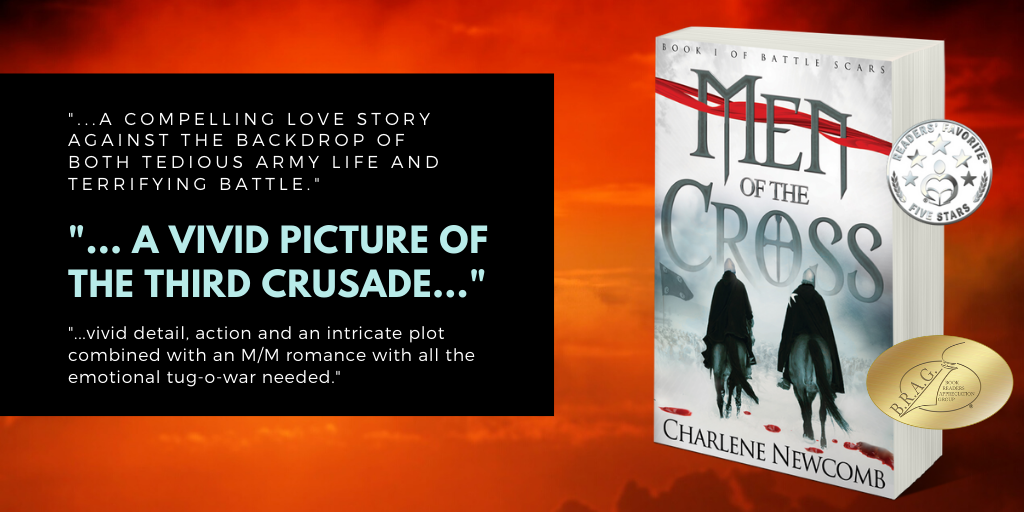
In my novel Men of the Cross, the naive young knight Henry de Grey hadn’t expected that leaving his Lincolnshire home early in 1190 to take the cross and join Lionheart’s crusader army meant about 15 months on the road/on the sea. After all that time, Henry and his comrades get their first look at the Holy Land.
Enjoy this excerpt
The galley drew into the harbour. The city of Acre had been under siege nearly two years. The pounding of the stone throwers drew Henry’s eye. Jerusalem’s fall had been the rallying cry for this call to arms, but the crusaders needed to secure Acre as a gateway. Without the great port, the desire to hold the Holy City in Christian hands would be nothing more than a dream.
Henry saw the smoke darkening Acre’s late morning skies. His mood blackened. He’d expected to see his first battle here, not in Messina. He hadn’t lost any friends that day, but he couldn’t forget that he’d come within a dagger’s width of an enemy blade. If it hadn’t been for Stephan’s true aim, he wouldn’t be looking at the land that had given a Savior to all Christians.
. . . THE WIND SHIFTED TO the west. Acrid smoke from the city drifted towards the ships, but Henry hardly noticed. Stephan had come up beside him, the sweat of swordplay glistening on his chest and back. He thwacked Henry on the buttocks with a cloth. Henry jerked, allowing only a half-hearted glare.
Stephan dried his face and rubbed down his body with the cloth in deliberate and slow moves. His stomach muscles tightened and the biceps in his arms bulged. Little John mimicked him, flexing his arms to show his budding physique. Stephan jabbed his fist at the boy, then tossed the dirty cloth to him in exchange for his tunic.
Fidgeting, Henry looked past them both, well aware of the grin on the boy’s face.
“Allan plans to take bets on Little John,” Stephan said, tugging the light brown shirt over his head. “He thinks he will beat any of the knights’ squires. Did you see how he feinted to the left then brought his staff up under my sword?”
Henry smiled as Little John disappeared below deck. “He has a good teacher.”
Stephan tilted his head back proudly. “So I’ve heard.”
Henry ignored the boast, focusing on the land beyond Acre’s impressive stone walls. Stephan followed his gaze. “Are those Saladin’s troops?” Henry asked. “There must be thousands of tents.”
Robin’s earlier report became a reality. Acre jutted out into the sea like a thumb on a hand. Water surrounded it on three sides. Mountains to the north, plains sweeping towards forested hills in the east and southeast. Henry remembered how Roger thought there’d be nothing but desert and blowing sands. He would have liked the trees, though they were nothing like ones in England.
“Saracens to the north,” Stephan said, and then nodded his head to the east and southeast, “and more of the infidels there.”
Henry shivered. Tents of every shape and size scarred the landscape, boasting the colours of sunsets and clouds. It was nothing like his first sighting of the king’s camp back in Tours. Here, Saladin’s army surrounded the crusaders.
><><><><><><><
Charlene Newcomb’s passion for historical fiction and Star Wars led to her writing a bit of both. She has multiple short stories in the Star Wars Adventure Journal, published a space opera Echoes of the Storm, and has written medieval historical fiction short stories and five novels: the Battle Scars trilogy, and Tales of Robin Hood.
Download her free medieval short story, A Boy’s Life – about 9 year old Allan A Dale – and dive into 12th century England.
Leave a Reply
You must be logged in to post a comment.